
Agentic systems
SonicMind Connect
Conversations become accountable action.

Conversations, evidence and action
SonicMind Connect brings source material, voice interaction, report generation and controlled execution into one workspace. I led architecture and end-to-end implementation during the Qendryx engagement, connecting applied AI capabilities to explicit application state and useful artifacts.
Problem and operating context
A meeting transcript is not yet a dependable report, and a report is not authorization to execute an external action. The system needs to preserve source context, validate outputs and make the difference between content creation and action delivery visible.
My responsibility
My scope covered multi-agent workflows, knowledge retrieval, enterprise integrations, provider connections and controlled AI-assisted execution. TypeScript and Python connect the interface, orchestration, realtime voice and long-running workers.
System architecture
The product contains multiple execution paths. ReportFlow handles validation, aggregation, routing and executor dispatch. The browser scheduler uses a LangGraph StateGraph with token and origin checks. A checkpoint wrapper provides conditional routing and supported persistence hooks. Hermes manages staged work, artifact guards, approvals and interruption. These are distinct responsibilities, not one universal graph.
Technical decisions
An agent is a bounded responsibility; some components use models and others perform deterministic work. Each contract should define accepted inputs, permitted actions, output shape and completion conditions. Source, session, run, step and artifact identity let the system connect outputs without inventing a one-to-one relationship.
Implementation details
LiveKit handles room transport and agent dispatch. The Python voice worker connects speech processing to transcript entries and recording finalization. ReportFlow uses independent executor outcomes collected with Promise.allSettled. MCP adapters expose tool capabilities; Jira, Confluence and Calendar integrations belong to the action boundary.
Production challenges
Provider timeout, missing evidence, denied authority and an unknown remote outcome require different responses. A delivery failure does not automatically invalidate a completed report. Before repeating an external action, reconcile whether it already happened. Completed artifacts should remain available when partial failure does not invalidate them.
Evaluation and observability
AI Activity projects events from several runtime producers. It should distinguish running, waiting for input, awaiting approval, partial completion and failure. Correlation connects visible activity to the underlying operation. The portfolio documents contract, integration, voice, permission and recovery test areas; it does not claim a fresh numerical reliability campaign.
Evidence and scope
The supplied 38-page book ties its explanation to eight groups of implementation references, including report contracts, ReportFlow, scheduler graphs, LiveKit and Hermes. Pages 21–25 distinguish scheduler and action execution. Pages 31–34 cover recovery, authority, server operation and evaluation. No unsupported throughput or universal agent-count claim is used here.
Technology stack
TypeScript, Python, React, LangGraph, LangChain message integration, LiveKit, Supabase, MCP and provider adapters. Dedicated-server workers support long-lived browser and voice work while authentication, persistence and realtime transport retain their own service boundaries.
Screens and demonstrations
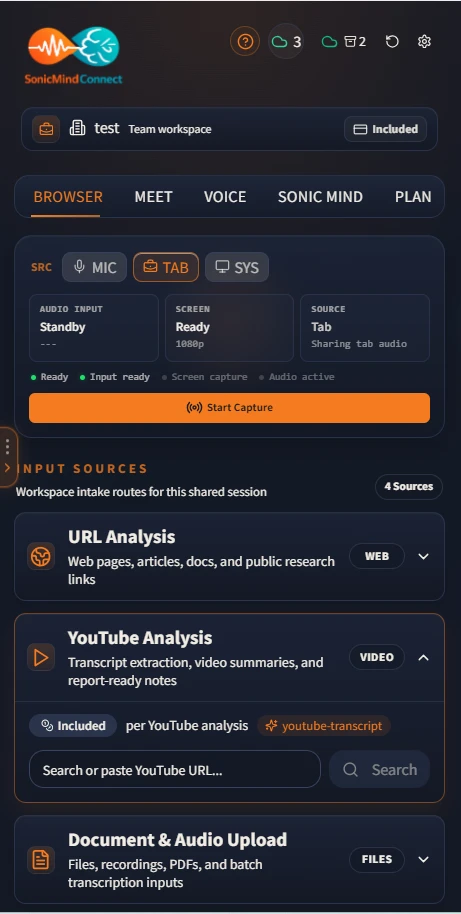
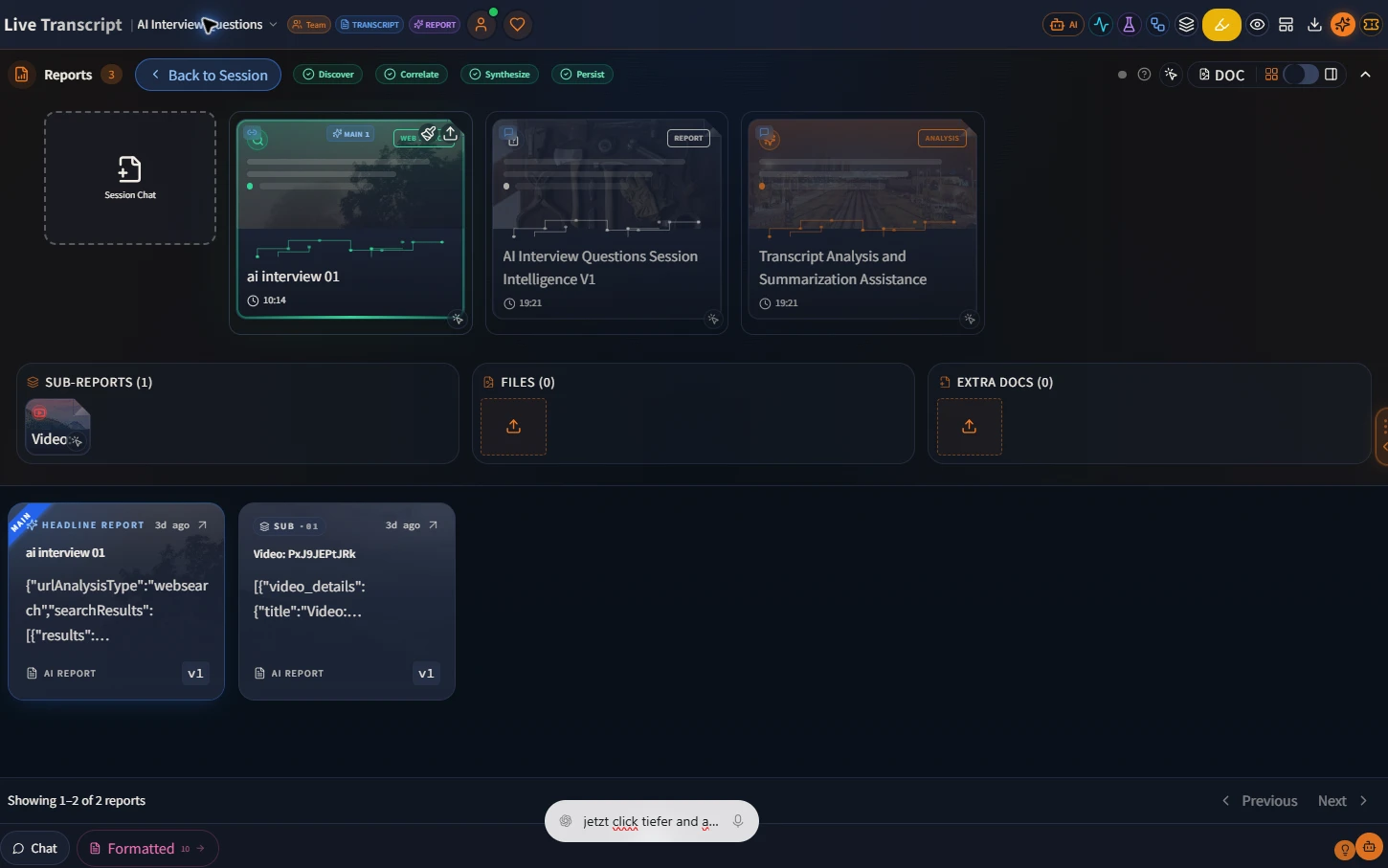
The source-intake and report-workspace screenshots below come directly from the supplied portfolio. They show product interfaces; the conceptual 3D flow summarizes responsibilities and does not represent a literal deployment topology.
Lessons and next steps
The work around a model determines whether an agent system can be operated. Further evaluation should connect curated source examples to expected decisions, groundedness, completeness and recovery scenarios, recording revision and configuration with every result. Approval must remain tied to the actual artifact and intended action.
Evidence & attribution
The supplied CV and engineering manuscripts establish role and contribution. Illustrations explain system responsibilities; they are not deployment maps or performance measurements.
sonicmind-applied-ai-engineering-book-v2.pdfNext system